The Jones Lab
Circadian circuits lab at Texas A&M University
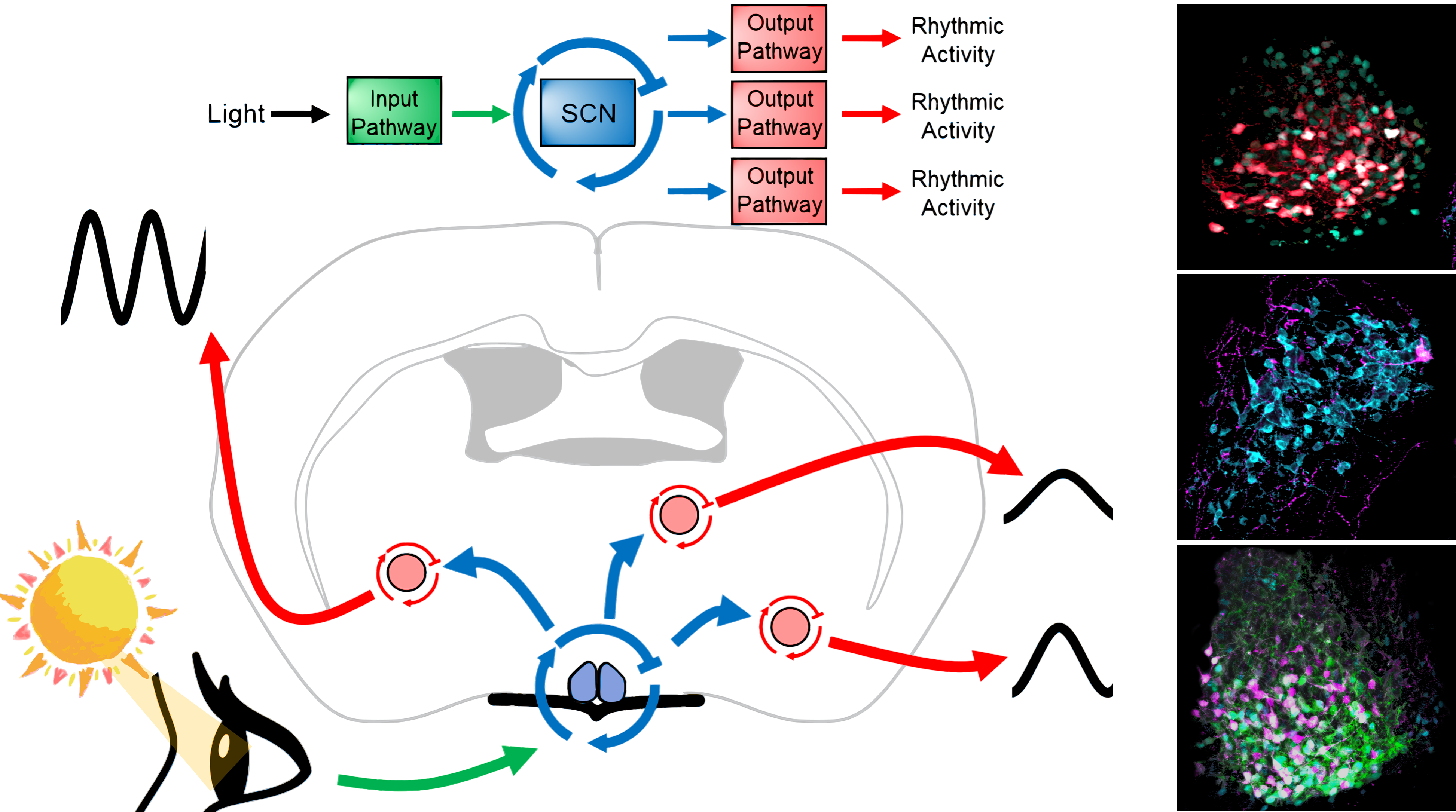
Behavior, cognition, neural activity, and physiology all change across the day, but they do not all change in the same way or at the same time. These rhythms are coordinated by the suprachiasmatic nucleus (SCN), the brain’s central circadian pacemaker, which sends timing signals through multiple output pathways. This creates the central question that drives the Jones Lab: how does one pacemaker organize so many differently timed outputs?
We study this problem across multiple levels of circadian organization. We ask how the intrinsic dynamics of the SCN differ across species and how defined output pathways shape the timing and duration of behavior. We also study how multiple behavioral rhythms are organized relative to one another and how circadian time changes the state and function of downstream neural circuits.
Because daily timing shapes so many aspects of brain function, circadian biology lets us study a wide range of neural systems within one coherent framework. These systems span movement, sleep, cognition, reward, hormonal signaling, and neuromodulation. Across them, we ask a common question: how is temporal information generated, transformed, and ultimately expressed as behavior and physiology?
To answer these questions, we combine circuit manipulation, long-term neural recordings, automated behavioral analysis, molecular approaches, and comparative species approaches. A particular strength of the lab is the ability to follow neural signals and behavior continuously across days and weeks, allowing us to study biological timing at the timescales on which it actually operates.
Our work supports a view in which circadian timing is not distributed as one uniform signal. Instead, it is transformed by pacemaker dynamics, output pathways, behavioral organization, and downstream circuit state. We are extending this framework to understand how these levels interact across species, within output circuits, and in disease.