Abstract
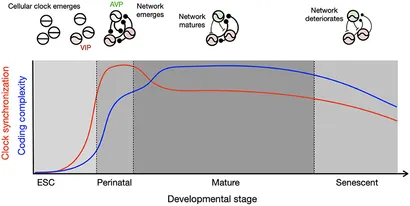
In multicellular organisms like ourselves, there exists not only a single circadian clock but rather a network of clocks throughout the body that operate in coordination. The central pacemaker of this system is the suprachiasmatic nucleus (SCN). The SCN is itself synchronized to the environment by local external light-dark cycles and it then communicates this information to the rest of the body. However, this is not a steady state relationship: As our bodies undergo changes throughout their developmental trajectory, there are corresponding adjustments in circadian organization. These adjustments necessitate consideration not only of external synchronizing cues, but also internal circadian cues that entrain and organize clocks throughout the body.