Abstract
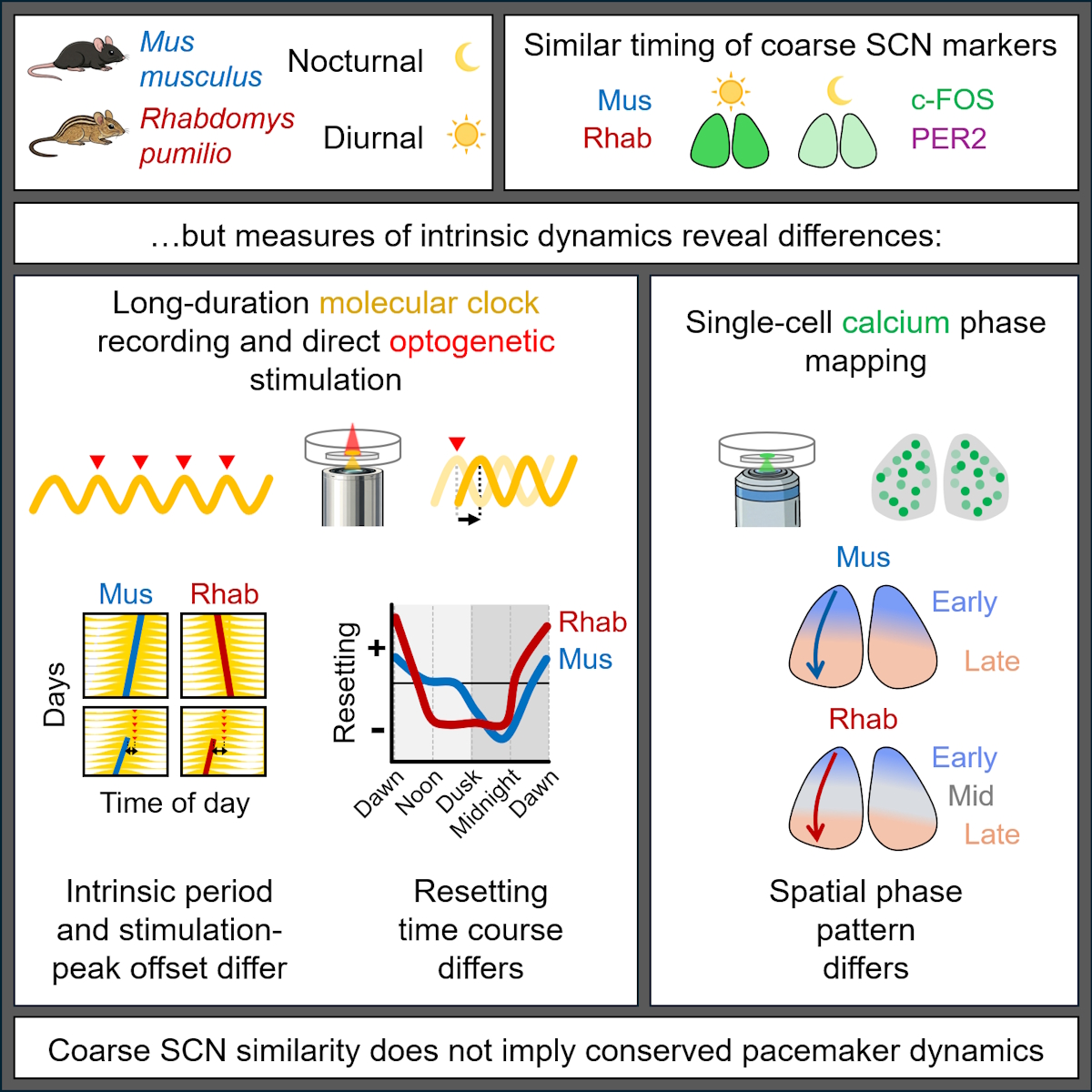
Diurnal and nocturnal mammals are thought to share a functionally equivalent suprachiasmatic nucleus (SCN), the central circadian pacemaker, because standard measures look broadly similar across species. However, coarse readouts do not test when the SCN can be reset or how timing is coordinated across SCN space. We used long-duration ex vivo recordings, optogenetic perturbation, and single-cell calcium phase mapping to compare network dynamics in the nocturnal laboratory mouse (Mus musculus) and the diurnal four-striped grass mouse (Rhabdomys pumilio). Rhabdomys SCN molecular clock rhythms exhibited a longer intrinsic period than Mus and reached a different phase relationship to daily stimulation. Direct SCN stimulation at defined circadian times produced species-specific resetting responses, including a pronounced mid-subjective-day delay in Rhabdomys when Mus responses were minimal. Calcium phase mapping revealed a graded dorsomedial-to-ventrolateral progression in Rhabdomys and a sharper transition in Mus. Thus, coarse SCN similarity does not necessarily imply conserved pacemaker dynamics across species.